November 2026 · #30DayMapChallenge 2026 · Day 25
Day 25 - Is This a Map?: A Map You Can Hear
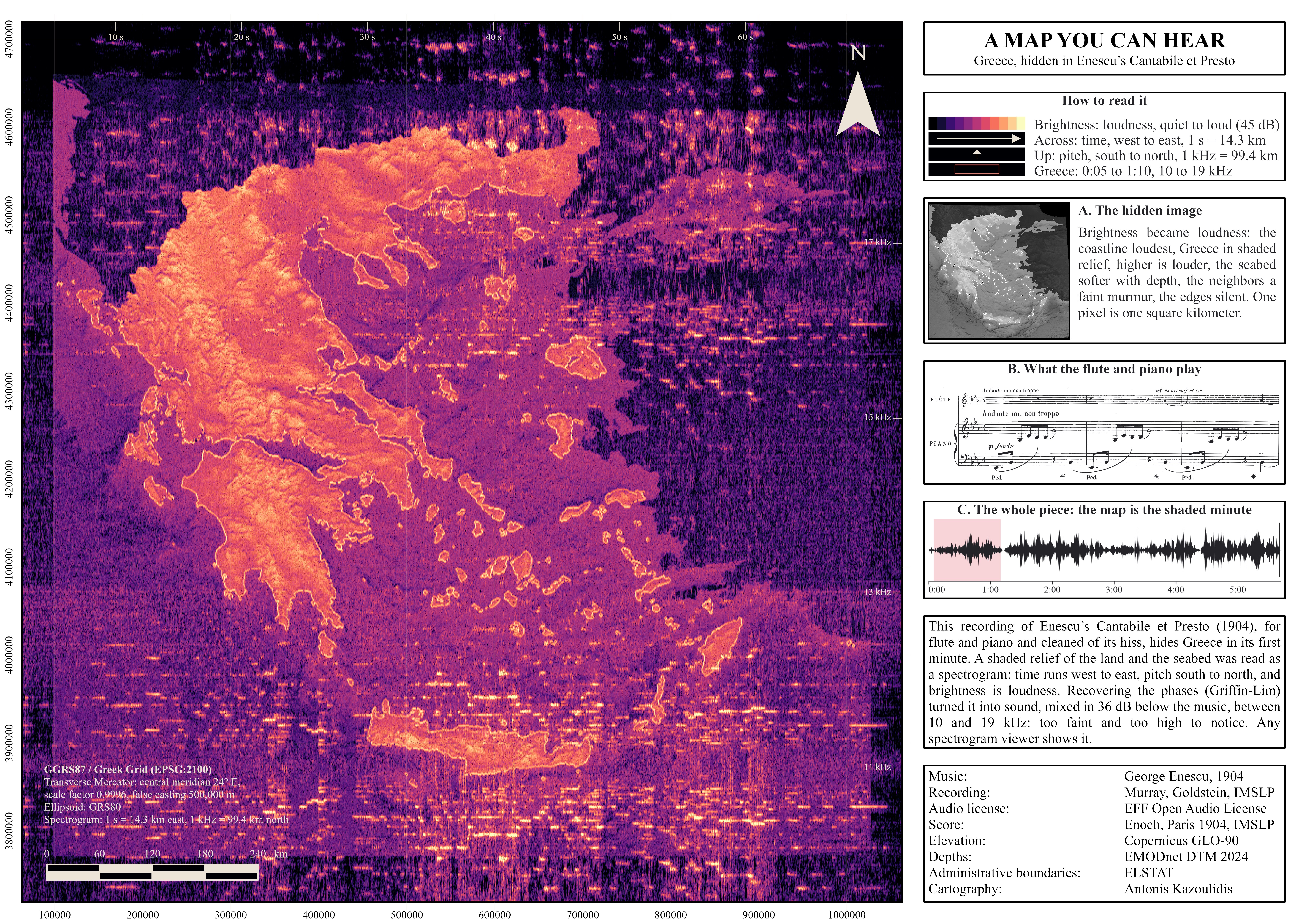
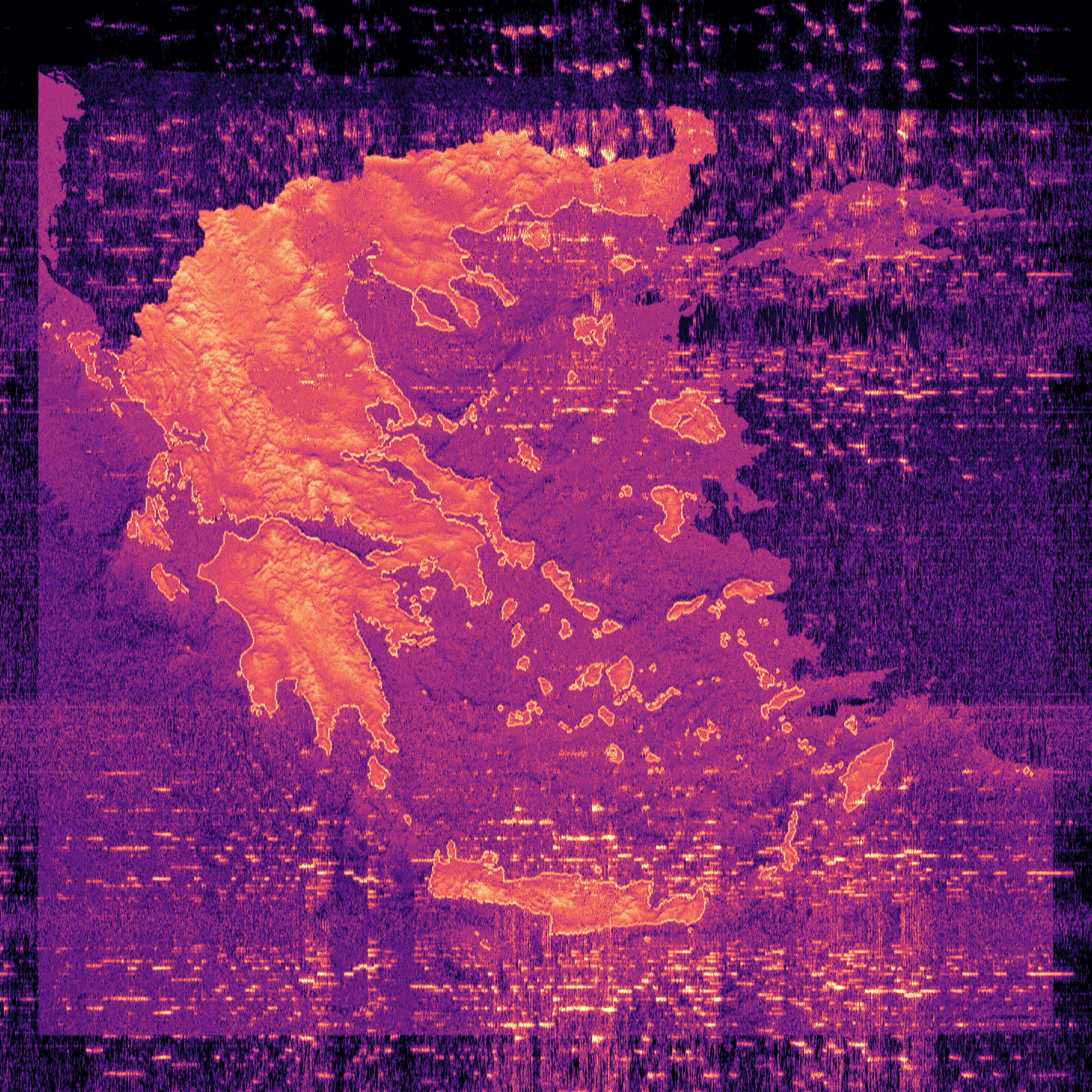
A 1904 piece for flute and piano with a map of Greece hidden in its first minute. The shaded relief of the land and the seabed was turned into sound, too high and too quiet to notice, so the music sounds as it always did. Press play and the page listens and draws what it hears: Greece appears, west to east.
Printed map
Press play: the page listens to the recording and draws what it hears.
Across: time. Up: pitch, 9 to 20 kHz. Brightness: loudness. Greece plays from 0:05 to 1:10, between 10 and 19 kHz: too high and too quiet to notice.
Downloads
- Full-resolution mapJPEG · 7016 × 4961 · 8.6 MB
- Square mapJPEG · 4724 × 4724 · 7.1 MB
- The recording with the hidden mapFLAC · 5:42 · 14.8 MB · open it in any spectrogram viewer
- George Enescu, Cantabile et Presto (1904), performed by Alexander Murray (flute) and Martha Goldstein (piano), Al Goldstein Archive, via IMSLP - EFF Open Audio License; this version is shared under the same license
- George Enescu, Cantabile et Presto, first edition (Paris: Enoch & Cie, 1904), via IMSLP - public domain
- Copernicus DEM GLO-90 - the land
- EMODnet Bathymetry DTM 2024 - the seabed
- Hellenic Statistical Authority (ELSTAT) - the Greek coast and boundaries, which separate Greece from its neighbors
Prompt: Is this a map?
It is a recording of Cantabile et Presto, a short piece George Enescu wrote in 1904 for flute and piano. It sounds like one, too. But in its first minute, in pitches too high and too quiet to notice, it carries a shaded map of Greece: the mountains, the islands, the seabed and, very faintly, the coasts of the countries around it.
I chose the piece after hearing it live, played by Fani Valtadorou (flute) and Nikolay Marinov (piano). The recording here is a different one, by Alexander Murray and Martha Goldstein, the only one I could find that is free to reuse and change.
You hear the map without knowing. You can see it, by drawing the sound the way acousticians do, as a spectrogram: time runs from left to right, pitch from bottom to top, and the louder a pitch is at a moment, the brighter that point. Draw this recording that way and Greece appears.
A spectrogram is a map
The spectrogram on the sheet is georeferenced. Time is easting and pitch is northing, so one second of music is 14.3 km of Greece from west to east, and one kilohertz is 99.4 km from south to north. The hidden Greece lies exactly on the real one, so the grid, the scale bar and the north arrow on the sheet are all true. Greece plays from 0:05 to 1:10, between 10 and 19 kHz.
How it was made
- The recording is from IMSLP, the free music library, under a license that allows changes. It was cleaned of its hiss first: the steady noise of the old recording was learned from the whole piece and turned down wherever no note rises above it.
- The image is a shaded relief of Greece at one pixel per square kilometer, from the Copernicus elevation model on land and the EMODnet bathymetry at sea. Brightness was chosen to become loudness: the coastline loudest, the land louder the higher it is, the seabed softer the deeper it goes, the neighbors a faint murmur.
- Into sound: each column of the image became the pitches of a few hundredths of a second. An image only says how loud each pitch is, not how its waves line up, so the alignment was found by repeated guessing and correcting (the Griffin-Lim method) until the sound drew the image back.
- Into the music: the result was mixed in 36 dB below the music, between 10 and 19 kHz, where the flute and piano are quietest and the ear is least sensitive. In a listening test the two versions could not be told apart.
- For the web, the recording is an MP3 at 256 kbit/s, the format that kept the map sharpest of those tested; AAC, Opus and smaller MP3s blurred it more. The lossless FLAC is in the downloads.
The printed map was made in ArcGIS Pro and the sound in Python. Enescu dedicated the piece to Paul Taffanel, who taught the flute at the Paris Conservatoire; it was written as a test piece for its students.